
Beloit's Largest!
A river rescue, a pair of red briefs, and the first time I understood how conditional admiration can be.

(An excerpt from what I’m working on).
The sun hammered my back as I dragged the water cart across the Grand Avenue bridge—three hundred pounds of sloshing water in a forty-gallon drum welded to a go-kart base. Let the guy who built it try pulling it across town.
It was summer after freshman year at Carroll College. My job was planting flowers and trimming bushes for downtown businesses. Each morning was the same: retrieve the cart, fill it, pull it through downtown. And sweat. Always sweat. Four more days until I’d see Mary.
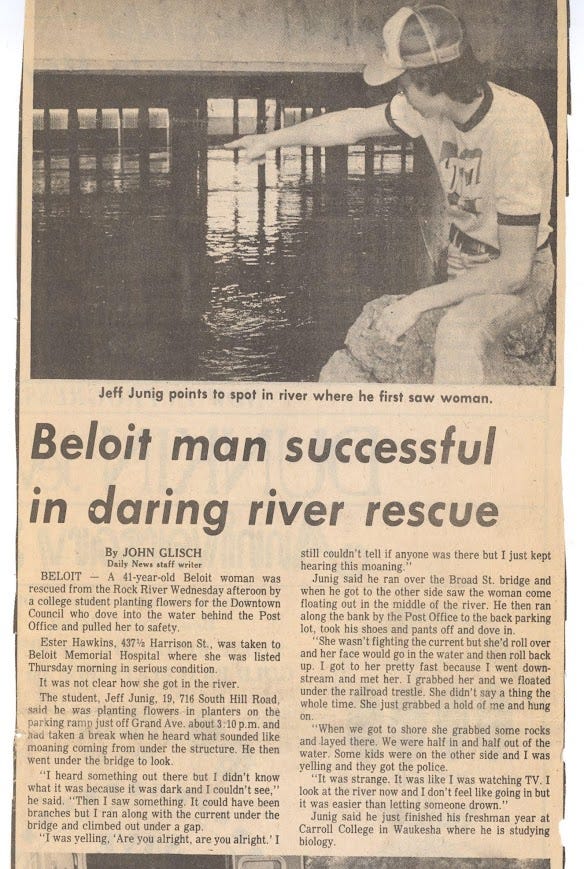
Damn, is it always this hot in May? I should’ve worn shorts. But this breeze—finally—wasn’t bad. I felt sweat drip down my back as I dragged the cart toward the riverfront parking structure, where I remembered a shady gap between buildings. I ditched the metal beast and slipped down to the water’s edge. Shade.
Two junior high kids were smoking a joint in the shadows. “What’s up?” I asked. They vanished. I had the darkness to myself. The river was high—normal for May. I sat on gravel, taking in the smell: mildew, concrete, and something acrid. I loved rivers. Even the stink felt familiar.
And then, a thought: What if someone needed saving here? The swirling current, the shadowed concrete, the echo of cars overhead—it felt like a place where something bad could happen. Would I go in? The question came with a chill. Not wondering—preparing.
Moments later, a sound cut through the quiet. A siren? A scream? Something was moving fast in the current. Too small for a raft. I stepped toward the edge and saw… a bundle? Clothing? A head bobbed up, then disappeared. A woman’s face.
No time. The river narrowed past the bridge into woods. If she got there, no one would see her. I sprinted along the bank, stripping off shoes, yanking down jeans. Calm now, weirdly calm. Like I’d done this before.
I dove from a concrete slab into the cold. It hit like steel. My chin went under. The water smelled like metal and strawberries—a trick from the sewage plant downstream.
She was thirty feet ahead. I swam hard, legs kicking shallow, fingers brushing past invisible junk—wire, shopping carts, maybe a snapping turtle. I grabbed her coat.
Her eyes were wide, mouth half-open. She clutched me with both hands. I pushed her off gently and held her coat instead, towing her with a sidestroke. The trestle passed overhead. Ground rose beneath my feet. We made it. I dragged her to shore.
Her face looked like The Scream, but with foam and bubbles. Was she breathing? Something blocked her throat—dentures, slick and hard. I pulled them out and tossed them. A breath. Faint, but real.
Across the river, some kids watched. “Get help!” I yelled. They vanished. Minutes later, sirens.
Firefighters and medics arrived with a stretcher. “We got it,” one said. He listened to her chest, rolled her onto the board.
I stood there in bright red briefs.
“Can I find my pants?” I asked.
“Questions first,” said the officer.
We walked upstream to my clothes. Why red today? I thought. My T-shirt said “Beloit’s Largest.” Great.
No one got a photo. But the story spread. “Hey, it’s Beloit’s Largest!” people said in bars. A little attention never hurt.
My boss gave me a ride home. “You did a good thing,” he said. The second most sincere thing I heard.
The first was from the woman herself, weeks later. Tiny, maybe eighty pounds. “Thank you for saving my life,” she said.
My parents were stunned when I got home early. Dad called the radio station. “They want you on the air!” he said, handing me the phone.
I mumbled: “I saw a woman drowning and jumped in the river.” That was it. Thirty seconds of fame. I had no idea how to be a hero.
Later, Kent and I smoked a joint at Leeson’s Park. “It was so messed up,” I said.
“So fucked up,” Kent replied, exhaling slowly.
A couple newspaper guys found us. My parents told them where to look, they said. We led them to the spot. In the days that followed, articles ran with headlines like Maintenance Man Rescues Woman from River and Valor and Selflessness Are Not Dead. One paper showed me with a stoned grin under my afro. Maintenance man? Better than college student.
For weeks, I wondered about that earlier thought—the premonition. Did I hear her somehow? No, too much time between. But I promised myself: Always remember what happened.
She was schizophrenic, they said. Known for yelling at women outside the grocery store. Some said it was a suicide attempt. Others said she wanted to see if she could swim.
I got some “hero” treatment downtown. But admiration faded. Then came the judgment.
At the hardware store, a guy loading mulch into his truck said, “You risked your life for a crazy BLACK woman?! What were you thinking?”
Outside the bank: “I bet you were surprised by what you saved… couldn’t you let her drown?”
These weren’t outliers. They were neighbors. Churchgoers. Good people—supposedly.
I watered flowers and kept my mouth shut. But I learned something that summer. Heroism isn’t rewarded for what you do, but for who you do it for. And sometimes, the world decides it wasn’t worth it.
But she thought it was. And that was enough.